| Sign Up For Our Newsletter |

| Sign Up For Our Newsletter |
F to C Temperature Conversion
An on-line physics tutorial
Fahrenheit to Celsius
temperature conversionwritten by Bill Byles
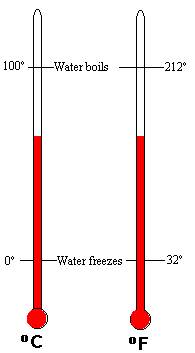
Celsius to Kelvin temperature conversion is simple because both scales have the same size degree. There are 100 Kelvins between the boiling and freezing points of water and 100 Celsius degrees between the same two points. Fahrenheit to Celsius is a different matter. On the two thermometers to the left, notice that there are 180 Fahrenheit degrees between the boiling and freezing points of water. Conversion from Celsius to Fahrenheit must take into account the smaller degree size on the Fahrenheit scale.
Step 1
- Find the ratio of Fahrenheit degrees between the boiling and freezing points of water to Celsius degrees for the same two points.
- Fahrenheit degrees between the boiling and freezing points of water = 180
- Celsius degrees between the boiling and freezing points of water = 100
- Fahrenheit to Celsius ratio = 180 : 100 = 1.8 : 1
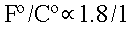
This means that for every 1.8 degrees that temperature changes on the Fahrenheit scale, temperature will change 1 degree on the Celsius scale. Thus the ratio of F º to C º is 1.8 : 1
Step 2
- Understand the distinction between º F and F º
- º F represents a specific temperature on the Fahrenheit scale. For example: pure water freezes at 32 º F.
- F º represents a range between two points on the Fahrenheit scale. For Example: between the freezing point of water and the boiling point of water, there are 180 F º
Step 3
- Convert the proportion in Step 1 to an equation. Than cannot be done by simply inserting an equal sign in place of the proportion signºF / ºC is not equal to 1.8 / 1
Step 4
- Pick a point on the two temperature scales where you know both temperatures. Express a ratio that would set both of the temperatures equal to zero by addition or subtraction. From the drawing above I could use either the boiling or freezing points of water. One equation which I could use would be: ºF - 32º / ºC = 1.8 / 1However, another equation that would be valid is:
ºF - 212º / ºC - 100º = 1.8 / 1The boiling or freezing of water is a constant temperature process. The change happens at a known temperature which remains constant during the completion of the process. These temperatures would be the most dependable to use, however others could be used. Absolute zero and the freezing point of mercury could also be used. The human body temperatures could be used as long as the temperature was known on both of the scales being used.
Step 5
- Isolate for the variable you are trying to solve for, and plug the known temperature in the equation.This process can be used to convert temperature on one scale to temperature on any other scale, even an imaginary scale. The process would be:
- Find the ratio of the numbers between the boiling and freezing points of water on both scales.
- Select any point on the two thermometers where you know the temperature on both scales
- Express a ratio that would set both of the temperatures equal to zero by addition or subtraction
- Isolate for the variable you are trying to solve for, and plug the known temperature in the equation.
Examples
Convert 50ºF to ºC
- Use the equation ºF - 32º / ºC = 1.8 / 1
- Isolate for ºC, begin by cross multiplying
- ºF - 32º = (1.8) ºC
- Isolate for ºC by dividing both sides by 1.8
- (ºF - 32º) / 1.8 = ºC
- Enter the given value for ºF
- (50º - 32º) / 1.8 = ºC
- 18º / 1.8 = ºC
- 10º = ºC
Convert 35 ºC to ºF
- Use the equation ºF - 32º / ºC = 1.8 / 1
- Isolate for ºC, begin by cross multiplying
- ºF - 32º = (1.8) ºC
- Isolate for ºF by adding 32º to both sides
- ºF = (1.8) ºC + 32º
- Enter the given value for ºC
- ºF = (1.8)(35º) + 32º
- ºF = 63º + 32º
- ºF = 95º
Problems
- Convert 98.2 ºF to ºC (human body temperature)
- Convert -40 ºC to ºF (yes, I am being tricky)
- Convert 1,000,000 ºC to ºF (if you are paying attention to significant digits, you don't need an equation)
- I have just invented a temperature scale which I am calling the Byles scale. On a Byles thermometer pure water freezes at 12.5 ºB and boils at 25.0 ºB. Using a Byles thermometer you measured the temperature to be 5.0 ºB. What would that temperature correspond to:
- on the Celsius scale?
- on the Fahrenheit scale?
Send your answers by Email, and I will respond. To send email, add @internet4classrooms.com to bylesb
Application idea:
Buy un-calibrated thermometers. Check the catalog of whatever science supply house you use, they are probably there. You need thermometers which have a range which will include 0 ºC and 100 ºC. Let your students determine the freezing and boiling points of pure water on their thermometers. After those points are marked they can decide on what calibrations they want to have for their thermometer. Students could call the freezing and boiling points of pure water anything they want to, and they could put any number of degrees between those two points.
Next Step:
- Students use their temperature to measure the temperature of something. They report to other students their two calibration points and their measured temperature. Others in the class must convert the temperature on the unknown scale to the temperature on some known scale (F, C, or K)
- Students must use their thermometers to measure the temperature of a substance whose temperature is known to the teacher but not to the student. They convert their reading to the temperature on the known scale the teacher is using. Measure their results by how close they come to the actual temperature. This would work best if you have a temperature probe connected to a computer or CBL.


Internet4classrooms is a collaborative effort by
Susan Brooks and Bill Byles.


advertisement
advertisement
Use of this Web site constitutes acceptance of our Terms of Service and Privacy Policy.